Flag of New Jersey
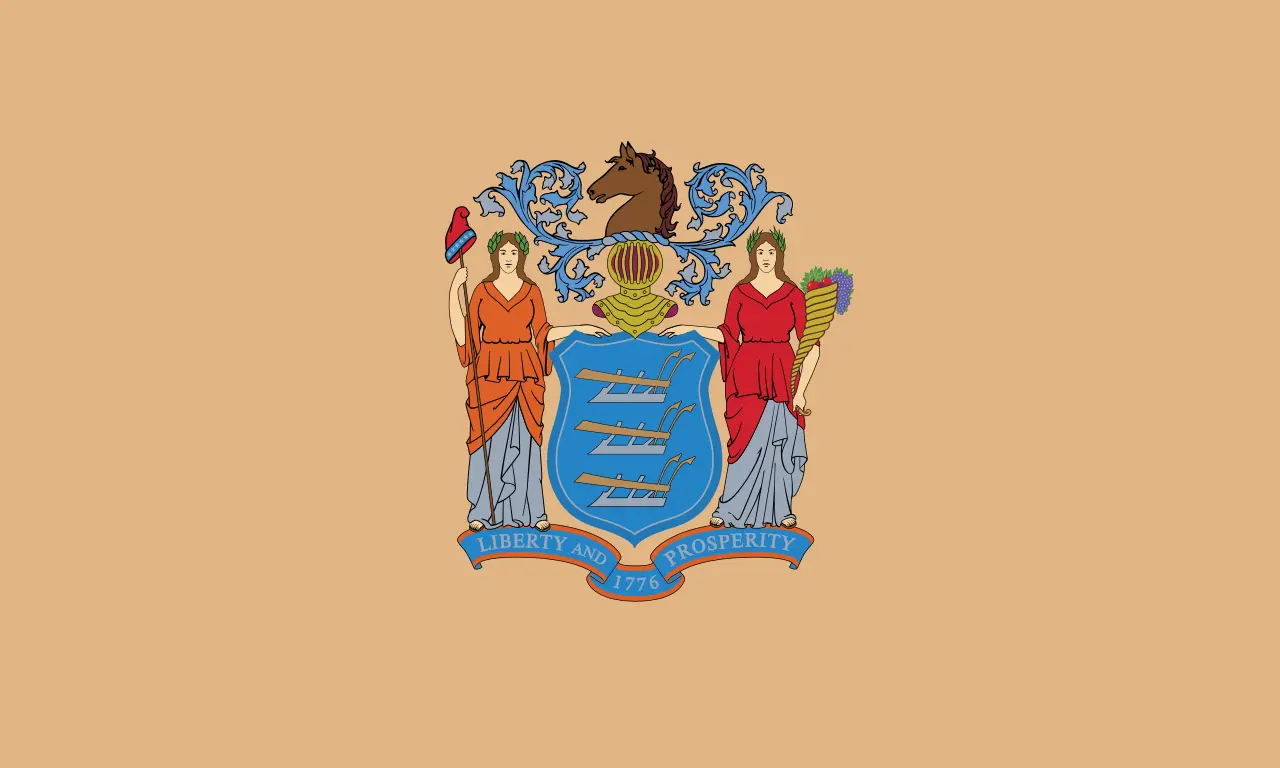
The flag of New Jersey is a field of buff with the state coat of arms in the center: a blue shield with three plows, held by the goddesses Liberty and Ceres, under a helmet topped by a horse's head, with the motto "Liberty and Prosperity" and the year 1776 below. Adopted in 1896, its buff background goes back to George Washington's orders for New Jersey's Revolutionary War uniforms.
What the flag shows
- The buff field. Buff is one of the two state colors, with Jersey blue. Since 1965 the law has fixed them as U.S. Army buff and royal blue, by their color-association cable numbers.
- The shield. A blue shield with three plows, for New Jersey’s farming tradition.
- The helmet and horse. A sovereign’s helmet above the shield, facing forward, topped by a horse’s head. Together they stand for New Jersey’s independence as a state.
- Liberty. On one side, holding a pole topped with a liberty cap, a symbol of freedom.
- Ceres. On the other side, the Roman goddess of grain, holding a cornucopia of the state’s produce.
- The scroll. Below, with the motto “Liberty and Prosperity” and the year 1776, when New Jersey became a state.
The coat of arms comes from the Great Seal, created by Pierre Eugène du Simitière in 1777.
Washington’s colors
The flag’s colors predate the flag by more than a century. In general orders of October 2, 1779, George Washington told the New York and New Jersey regiments of the Continental Army to wear blue coats faced with buff. Buff and blue became New Jersey’s colors, and the state flag, adopted in 1896, put the coat of arms on a buff field.
In 1965 the Legislature made buff and Jersey blue the official state colors for the flag and other uses, and pinned each to an exact shade.
Rules for the flag
A 2009 law requires any US or New Jersey flag bought with state money to be made in the United States. The flag shows the coat of arms rather than the Great Seal itself, whose use is limited by law to listed officials unless the secretary of state consents.
Questions about the New Jersey state flag
- Why is the New Jersey flag buff?
- Buff and Jersey blue are the colors George Washington picked for New Jersey's Revolutionary War regiments, whose blue coats were faced with buff. Since 1965 state law has made them the official state colors.
- What do the three plows on the New Jersey flag mean?
- They stand for the state's farming tradition.
- Who are the women on the New Jersey flag?
- Liberty, holding a pole topped by a liberty cap, and Ceres, the Roman goddess of grain, holding a cornucopia.
- Why is there a horse's head on the New Jersey flag?
- It sits on top of a sovereign's helmet above the shield, standing for New Jersey's independence as a state. The horse is also the state animal.
- What year is on the New Jersey flag?
- 1776, the year New Jersey became a state, on the scroll beneath the shield.
Sources
- Symbols State of New Jersey
- General Orders, 2 October 1779 Founders Online, US National Archives
- L.1965, c.170 (state colors) New Jersey State Library
- N.J.S.A. 52:2A-1, Official colors of the State of New Jersey FindLaw (New Jersey Statutes)
- N.J.S.A. 52:2-1, Great seal; description FindLaw (New Jersey Statutes)
- Requires that any United States or State of New Jersey flag purchased with State funds be manufactured in the United States (L.2009, c.86) New Jersey State Library