Flag of Delaware
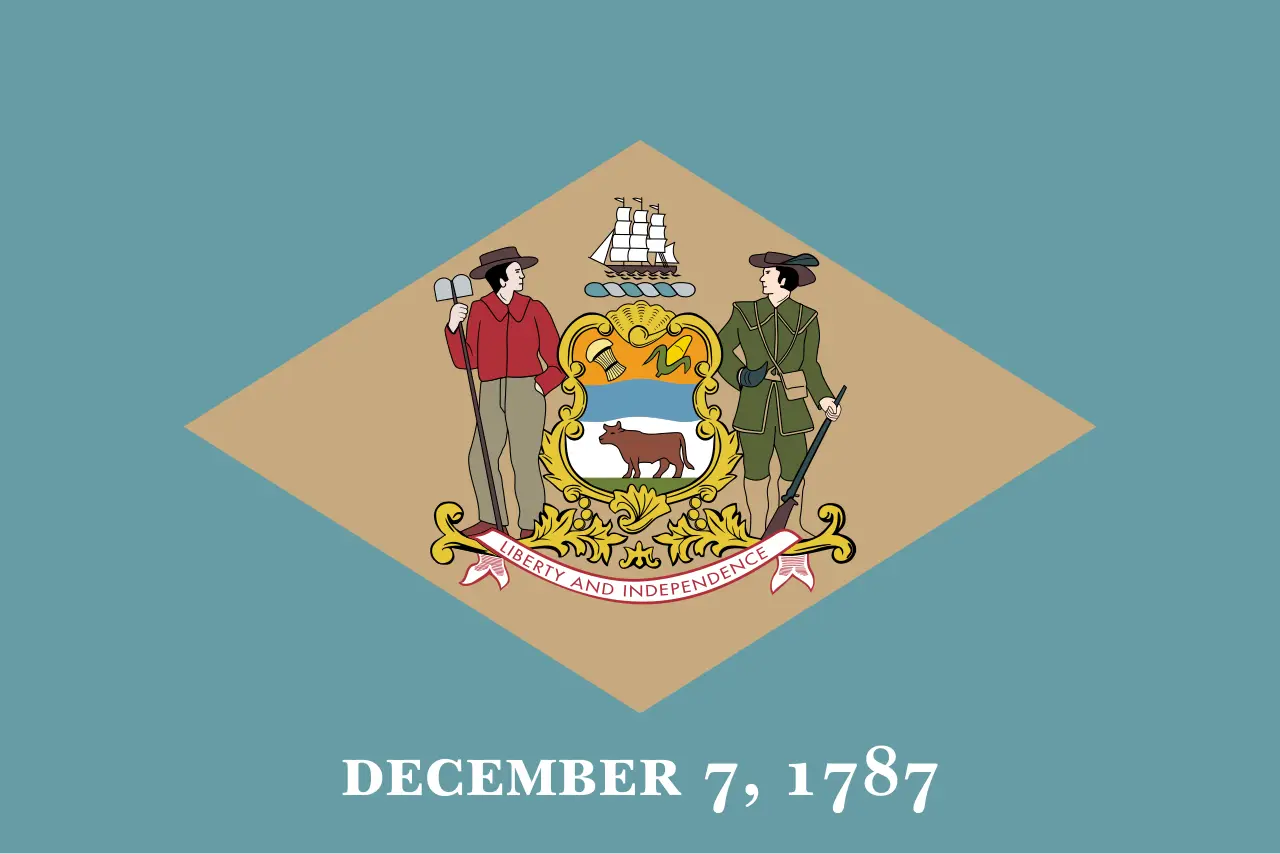
The flag of Delaware has a field of colonial blue around a buff-colored diamond that holds the state coat of arms. Below the diamond is the date December 7, 1787, the day Delaware became the first state to ratify the Constitution. A state commission chose the design in 1913, and its members said the blue and buff were the colors of George Washington's uniform.
Before the official flag
Delaware had no official flag until 1913, but blue state flags were in use long before. The Delaware Public Archives has records of one carried in the Civil War: at the Battle of Fredericksburg, Robert Hanna of the 2nd Delaware is recorded as carrying the blue flag of Delaware forward after the color-bearer was wounded.
A commission’s design
In 1913 the General Assembly created a commission to settle on an official flag and colors. On July 24, 1913, it chose the design used today: the coat of arms in a diamond on a blue field, with the date of ratification below. No individual designer is named.
The flag then had an odd legal history. It was left out when the Delaware Code was compiled, so in 1955 the legislature passed a new act to write it back into law. That act also fixed the exact shades, matching them to textile color cards: “Arno blue” for the field and “golden beige” for the diamond.
What the flag shows
- Colonial blue and buff. According to the commission’s members, the two colors match the blue and buff of George Washington’s uniform. They are also Delaware’s official state colors.
- The diamond. A buff diamond holds the coat of arms.
- The shield. Its upper panel, orange, shows a sheaf of wheat and an ear of corn, for agriculture; the wheat comes from the old Sussex County seal and the corn from the Kent County seal. A wavy blue band stands for the Delaware River. The lower panel, white, shows an ox, for animal husbandry.
- The supporters. A farmer with a hoe stands for farming, and a rifleman, or militiaman, for the citizen-soldier who defends liberty.
- The crest. A full-rigged ship under sail, for New Castle County’s shipbuilding and Delaware’s coastal trade.
- The motto. “Liberty and Independence,” on a ribbon below.
- The date. “December 7, 1787,” in white below the diamond.
The governor’s flag
Delaware’s governor has a flag of his or her own, set out in a 1955 law. It is the state flag with a gold fringe, carried on a staff topped by a model of a fighting Blue Hen rooster, the bird Delaware’s Revolutionary soldiers made famous.
Questions about the Delaware state flag
- What does the date on the Delaware flag mean?
- December 7, 1787, is the day Delaware ratified the US Constitution, the first state to do so.
- Why is the Delaware flag blue and buff?
- Members of the 1913 flag commission said the two colors match those of George Washington's uniform. A 1955 law fixed the exact shades as "Arno blue" and "golden beige."
- What is on the Delaware coat of arms?
- A shield with a sheaf of wheat, an ear of corn and an ox, divided by a wavy blue band for the Delaware River, held by a farmer and a rifleman, with a sailing ship above and the motto "Liberty and Independence" below.
- When was the Delaware flag adopted?
- A state flag commission set the design on July 24, 1913. Because the flag was later left out of the Delaware Code, a 1955 law wrote it back in.
Sources
- Laws of Delaware, Volume 50, Chapter 288 (state flag and colors) Delaware General Assembly
- Delaware Facts and Symbols State of Delaware
- Delaware Public Archives flag records Delaware Public Archives
- Delaware Code Title 29, Chapter 3. State Seal, Song and Symbols Delaware General Assembly (Delaware Code Online)
- Delaware Facts & Symbols Town of Viola, Delaware (state-hosted page; design and content by the Delaware Government Information Center)