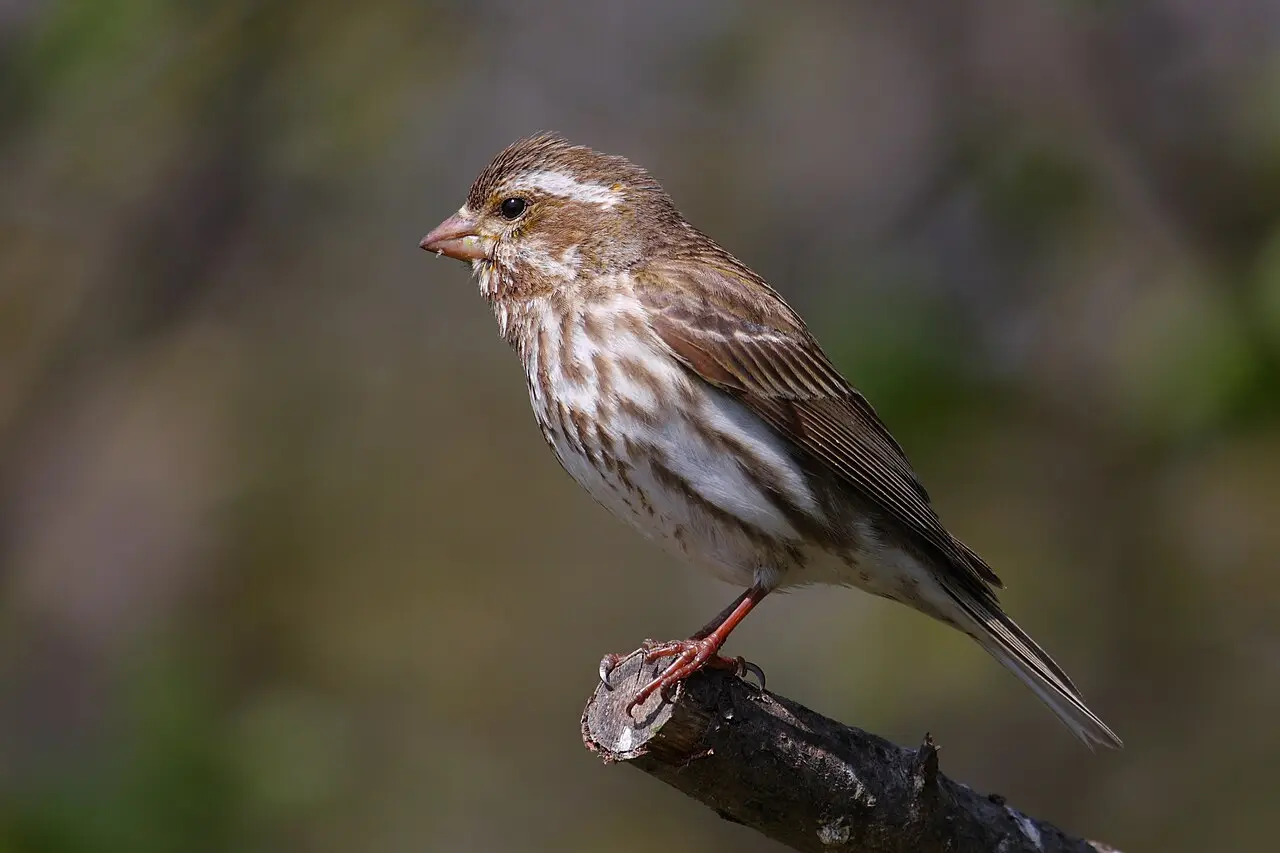
Purple finch, the state bird of New Hampshire
The state bird of New Hampshire is the purple finch, adopted in 1957. The male is not really purple but washed in raspberry red over the head and breast; the female is brown and streaky with a bold face pattern. It breeds in New Hampshire's conifer and mixed forests, but its numbers in the state are declining.
How to recognize it
The purple finch is a small, chunky finch about 5.5 to 6.5 inches long. Adult males are washed in a raspberry or rosy red, not really purple, over the head and breast, and they lack the strong dark streaks on the flanks that house finches show. Females and young birds are brown and heavily streaked, with a bold face pattern: a whitish stripe over the eye and a dark whisker mark. The song is a rich, fast warble, and in flight the birds give a sharp tick.
How it lives
Purple finches eat mainly seeds, buds and berries, adding insects such as caterpillars and beetles in spring. They feed in trees and shrubs and on the ground, and outside the nesting season they often move in small flocks. The female builds a compact cup of twigs, rootlets and bark strips high on a tree branch, and usually raises one brood a year. The species breeds in coniferous and mixed forests across Canada, the Northeast and down the Pacific Coast.
Where to see one in New Hampshire
Look in the state’s conifer and mixed woods, especially in the breeding season, and at bird feeders. In the Northeast the purple finch visits feeders less than it once did, possibly because of competition from introduced house sparrows and house finches.
A state bird in trouble
The purple finch is still widespread, but it is declining in the Northeast. Its numbers probably fell after house sparrows arrived in the late 1800s and dropped again in recent decades, likely because of competition with the house finch. NH Audubon’s Pam Hunt describes New Hampshire’s population as declining for reasons that are not fully understood, and a 2019 National Audubon Society climate study warned that even moderate warming could push the species out of much of the state.
The state bird since 1957
Representative Robert S. Monahan of Hanover, a Dartmouth College forester, filed the bill to make the purple finch the state bird, with backing from the Audubon Society of New Hampshire and federations of garden and women’s clubs. Representative Doris M. Spollett of Hampstead pushed a rival bill for the New Hampshire hen, a fight she had also lost eight years earlier as a senator. The finch bill moved quickly through both chambers, and Governor Lane Dwinell signed it on April 25, 1957.
Questions about the New Hampshire state bird
- What is the state bird of New Hampshire?
- The purple finch (Haemorhous purpureus), adopted in 1957.
- Is the purple finch really purple?
- No. Adult males are washed in a raspberry or rosy red over the head and breast. Females and young birds are brown and streaked.
- How do you tell a purple finch from a house finch?
- Male purple finches lack the strong dark streaks on the flanks that male house finches have. Female purple finches have a bold face pattern, with a whitish stripe over the eye and a dark whisker mark, much stronger than on a female house finch.
- Is the purple finch declining in New Hampshire?
- Yes. NH Audubon describes the state's population as declining, for uncertain reasons, and a 2019 Audubon climate study warned that even moderate warming could push the species out of much of the state.
Sources
- Purple Finch National Audubon Society
- Report says climate change could push state bird out of New Hampshire New Hampshire Public Radio
- State Bird, New Hampshire Almanac New Hampshire State Library
- RSA 3:10 State Bird New Hampshire General Court