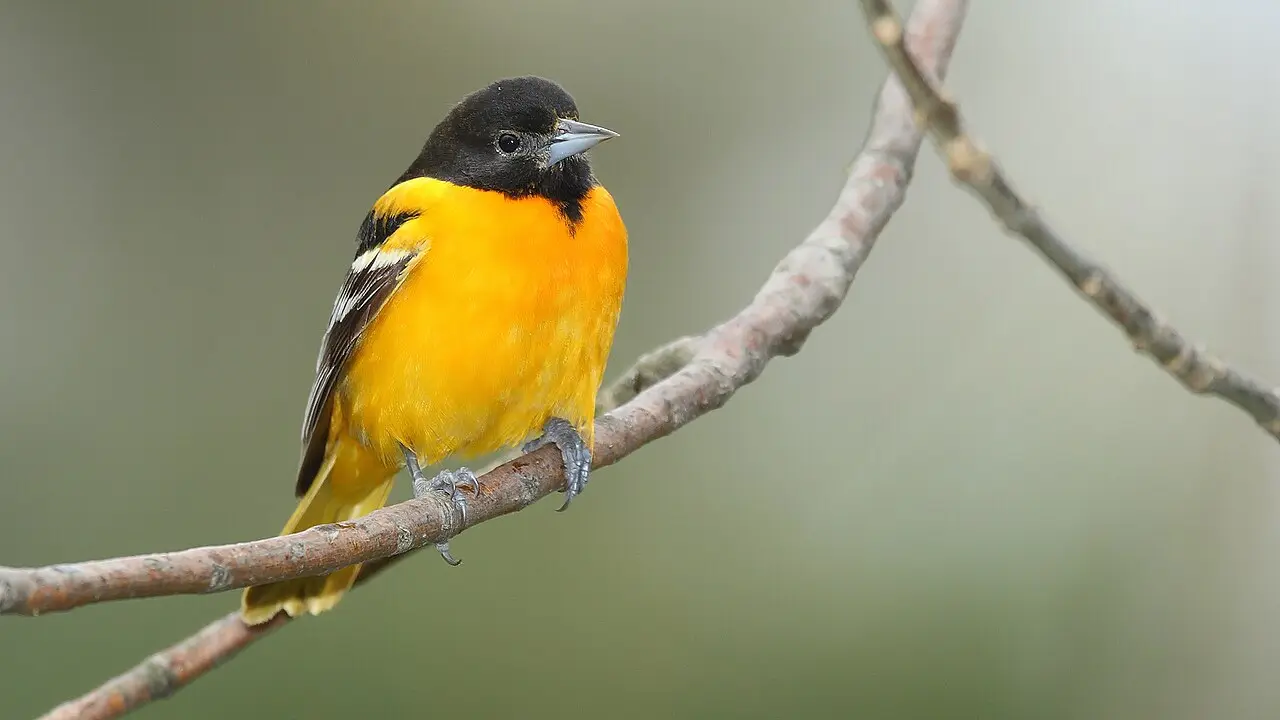
Baltimore oriole, the state bird of Maryland
The state bird of Maryland is the Baltimore oriole, adopted in 1947. The male's flame-orange and black plumage resembles the colors of the Calvert family, the Lords Baltimore, which is how the bird got its name. It nests across Maryland in spring and summer, weaving a hanging pouch high in a shade tree, and spends the winter in the tropics.
How to recognize it
The Baltimore oriole is a songbird about the size of a robin, seven to eight and a half inches long. The adult male is unmistakable: flame orange, with a solid black head, black back and wings with a white wing bar, orange sides and orange in the tail. Females and young birds are brownish above and dull orange or yellow-orange below, with two white wing bars and varying amounts of black on the head.
Its song is a short series of clear, flute-like whistles, and it varies a lot from one bird to the next.
How it lives
In the breeding season Baltimore orioles eat mostly insects, especially caterpillars, beetles and grasshoppers, which they pick from leaves high in the trees. They also eat fruit and sip nectar, and they visit feeders offering orange halves or grape jelly.
Their nest is a work of art. The female weaves a hanging pouch of plant fibers, grasses and string, suspended from the tip of a high, drooping branch where predators cannot easily reach it. Both parents feed the young. In late summer and fall most Baltimore orioles fly south to spend the winter in Central and South America.
Where to see one in Maryland
Baltimore orioles nest throughout Maryland in spring and summer, though they are less common on the Coastal Plain. Look and listen high in large shade trees along roads, in towns and parks, and at the edges of woods near streams. They are easiest to find in May, when males are singing and the leaves have not fully filled in.
A bird in decline
The Baltimore oriole is still widespread, with a population of about 12 million, but it is declining. The Maryland Department of Natural Resources reports a decline of about 1.6 percent a year in Maryland since 1980. One suspected cause is the loss of the tall American elms, killed by Dutch elm disease, that orioles once favored for their nests.
The state bird since 1947
The oriole’s link to Maryland goes back to its name, given for its resemblance to the Calvert colors. Maryland gave the bird special legal protection as early as 1882, and in 1947 the General Assembly made it the official state bird. Baltimore’s major league baseball team, the Orioles, is named for it.
Questions about the Maryland state bird
- What is the state bird of Maryland?
- The Baltimore oriole (Icterus galbula), adopted in 1947.
- Why is it called the Baltimore oriole?
- The male's orange and black feathers resemble the colors of the coat of arms of the Calvert family, the Lords Baltimore, who founded Maryland.
- When can I see Baltimore orioles in Maryland?
- In spring and summer, when they nest across the state. Most leave for Central and South America in late summer and fall.
- Is the Baltimore Orioles baseball team named after the bird?
- Yes, Baltimore's major league team takes its name from the state bird.
Sources
- Baltimore Oriole National Audubon Society
- Baltimore Oriole Maryland Department of Natural Resources
- Maryland State Bird Maryland State Archives