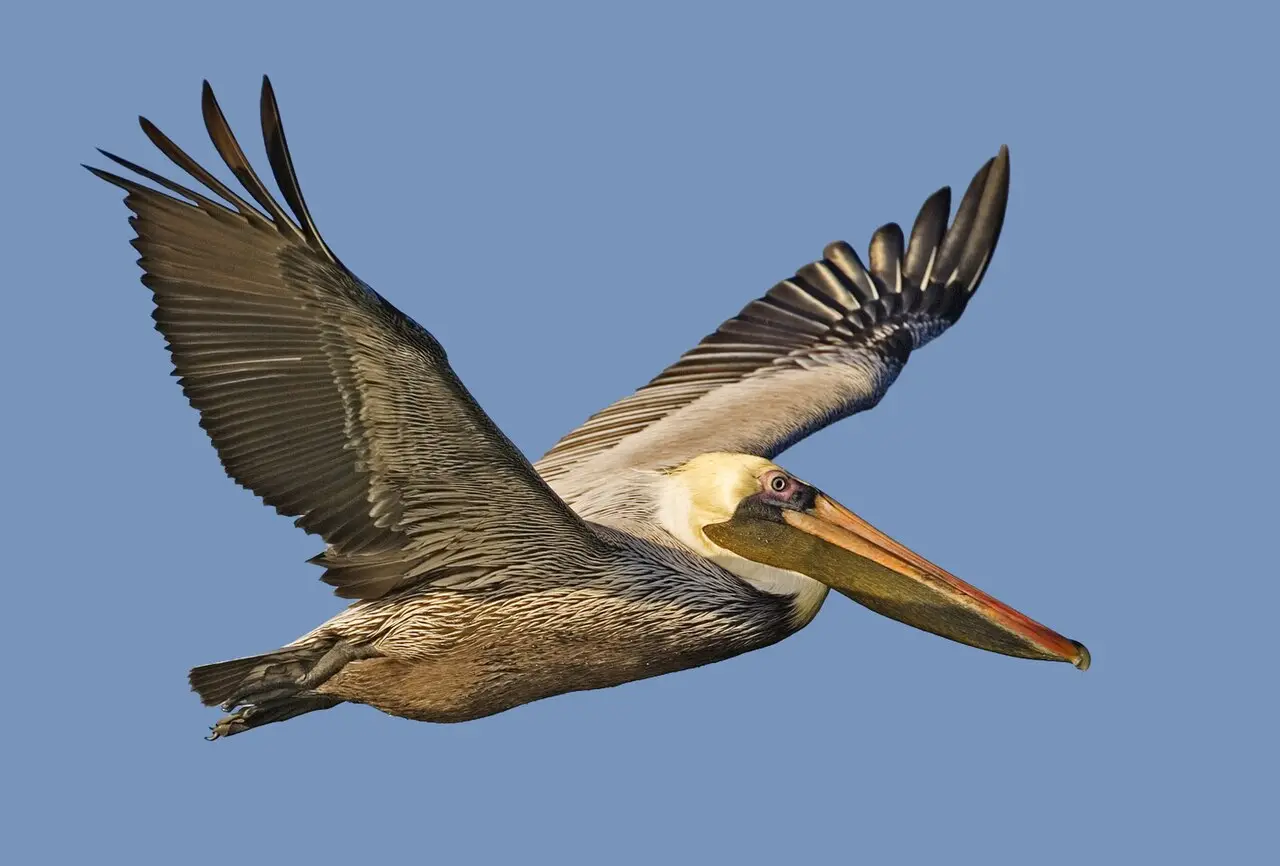
Brown pelican, the state bird of Louisiana
The state bird of Louisiana is the brown pelican, adopted in 1966. It is a huge seabird that dives headfirst into the water to catch fish in its pouch. By 1963 pesticides had wiped it out in Louisiana entirely, and the state rebuilt its population with young birds brought from Florida. Today brown pelicans are common again along the Louisiana coast.
How to recognize it
The brown pelican is a very large, heavy-bodied seabird, about three and a half to four and a half feet long, with a wingspan of about six and a half feet and a weight of four to nearly nine pounds. Its most famous feature is its huge bill, with a stretchy pouch underneath.
Adults are silver-gray above with a blackish-brown belly. Outside the breeding season their heads are white with a yellowish crown; in breeding season the back and sides of the neck turn a deep chestnut brown. Young birds are a duller gray-brown above with a pale belly. Pelicans are mostly silent, though adults grunt at their nesting colonies.
A spectacular fisher
Brown pelicans eat almost nothing but fish, such as menhaden. They hunt by diving: a pelican flying over the water spots a fish, folds its wings and plunges headfirst from as high as about 60 feet, hitting the water with a splash. It scoops the fish into its pouch along with a large gulp of water, drains the water out, and then swallows. Flocks of pelicans often fly low over the waves in a long line, rising and falling with the swells.
Where it lives
Brown pelicans live along coasts, in salt bays, on beaches and over shallow coastal waters. They nest in colonies on islands. In Louisiana they nest on barrier islands and marsh islands along the coast, such as Queen Bess Island in Barataria Bay.
Gone, and back
The brown pelican came close to disappearing. In the 1950s and 1960s the pesticide DDT and similar chemicals, washing into the Gulf, built up in the fish pelicans ate and made their eggshells so thin that they broke during incubation. In Louisiana the effect was total. Nesting stopped in 1961, and by 1963 there were no brown pelicans left in the state whose symbol they were.
Louisiana brought them back. From 1968 to 1976 the state’s wildlife agency moved 767 young pelicans from Florida’s Atlantic coast to coastal Louisiana. In 1971 the first 11 new nests appeared on Queen Bess Island. With DDT banned in 1972, the population recovered. The brown pelican was federally listed as endangered in 1970, removed from the list in the southeastern United States in 1985, and delisted across its whole range in 2009. Audubon now lists it as a species of least concern.
Where to see one
Brown pelicans are common again along the Louisiana coast. Look for them diving offshore, resting on pilings and docks, or flying in lines along the beach. Queen Bess Island, near Grand Isle in Jefferson Parish, is one of the state’s largest nesting colonies.
The state bird since 1966
The pelican had been Louisiana’s emblem since soon after statehood, appearing on the state seal and later the flag. The legislature made the brown pelican the official state bird from July 27, 1966, “in the form in which it already appeared on the state seal,” and directed its use on the seal, state insignia and official documents.
Questions about the Louisiana state bird
- What is the state bird of Louisiana?
- The brown pelican (Pelecanus occidentalis), the state bird since July 27, 1966.
- Why did brown pelicans disappear from Louisiana?
- DDT and similar pesticides made their eggshells too thin to survive. Nesting stopped in Louisiana in 1961, and the birds were gone by 1963.
- How were brown pelicans brought back to Louisiana?
- From 1968 to 1976 the state moved 767 young pelicans from Florida's Atlantic coast to coastal Louisiana. The first new nests appeared on Queen Bess Island in 1971.
- Where can I see brown pelicans in Louisiana?
- Along the coast. Queen Bess Island near Grand Isle, in Barataria Bay, is one of the state's largest nesting colonies.
Sources
- Brown Pelican National Audubon Society
- LDWF celebrates 50th anniversary of brown pelican restoration at Queen Bess Island Louisiana Department of Wildlife and Fisheries
- La. R.S. 49:159 (state bird) Louisiana State Legislature
- La. R.S. 49:159 Louisiana State Legislature