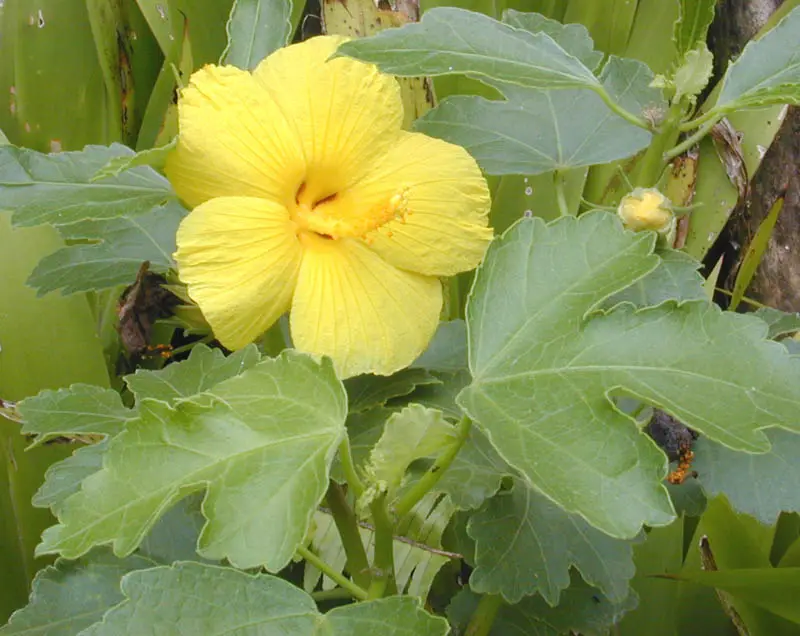
Yellow hibiscus, the state flower of Hawaii
The state flower of Hawaii is the native yellow hibiscus, known in Hawaiian as maʻo hau hele or pua aloalo, adopted in 1988. It is a shrub with large, bright yellow flowers that grows only in Hawaii, and all of its forms are endangered in the wild. Many people assume Hawaii's flower is a red hibiscus, and for decades the law left that open.
How to recognize it
The maʻo hau hele is a sprawling shrub, usually from about 2 to more than 10 feet tall and spreading 8 to 10 feet wide, though it occasionally grows into a small tree. Its flowers are the classic hibiscus shape, large and bright yellow, and some forms have a red or maroon center. Small prickles surround the base of each flower. The leaves are grayish to medium green, about two to six inches long, and slightly rough to the touch, like fine sandpaper.
It blooms mainly in winter and spring, from about February to May, with scattered flowers the rest of the year.
Found only in Hawaii
The yellow hibiscus is endemic to Hawaii: it grows wild nowhere else. It once grew in dry forests and shrublands below about 3,000 feet on Kauaʻi, Oʻahu, Molokaʻi, Lānaʻi, Maui and the island of Hawaiʻi. Today wild plants are rare and very localized, threatened by the loss of Hawaii’s dry forests, wildfire, grazing animals and invasive plants. The species has three subspecies, and all are federally listed as endangered.
Where to see it
Because wild plants are so rare, most people see the yellow hibiscus in cultivation. Native-plant nurseries grow it, and it does well in sunny, dry gardens and public landscapes, where it is a living reminder of Hawaii’s vanishing dry forests.
From “the hibiscus” to the yellow hibiscus
In 1923 the territorial legislature named “the hibiscus” as Hawaii’s flower without saying which one. Hawaii has many hibiscus species and countless garden varieties, and the flower most people pictured was a bright red one, the kind tucked behind the ear in postcards. In 1988 the state legislature settled the question by naming the native yellow hibiscus as the official state flower.
The law that names it, section 5-16 of the Hawaii Revised Statutes, was expanded in 2000 to give each of the eight main islands its own official flower or lei material: the ʻōhiʻa lehua for Hawaiʻi Island, the lokelani rose for Maui, the ʻilima for Oʻahu, mokihana berries for Kauaʻi, the kukui blossom for Molokaʻi, the kaunaʻoa vine for Lānaʻi, pūpū shells for Niʻihau and the hinahina for Kahoʻolawe.
Questions about the Hawaii state flower
- What is the state flower of Hawaii?
- The native yellow hibiscus, Hibiscus brackenridgei, called maʻo hau hele or pua aloalo in Hawaiian. It became the state flower in 1988.
- Isn't Hawaii's state flower a red hibiscus?
- No. A 1923 territorial law named "the hibiscus" without saying which one, and many people took that to mean the red hibiscus. A 1988 law made the native yellow hibiscus the official state flower.
- Is the yellow hibiscus endangered?
- Yes. All three subspecies are federally listed as endangered. Wild plants survive only in a few scattered dry forests and shrublands.
- Do the Hawaiian islands have their own flowers?
- Yes. Since 2000 each of the eight main islands has an official flower or lei material, such as the ʻōhiʻa lehua for Hawaiʻi Island and the ʻilima for Oʻahu.
Sources
- Hibiscus brackenridgei Native Plants Hawaiʻi, University of Hawaiʻi
- Hibiscus brackenridgei plant profile USDA PLANTS Database
- HRS § 5-16 (state flower and island emblems) Hawaii State Legislature (via Internet Archive)