Nēnē, the state bird of Hawaii
The state bird of Hawaii is the nēnē, or Hawaiian goose, adopted in 1988. It lives only in the Hawaiian Islands, where it evolved to walk on lava and graze on land rather than swim. In the 1950s only about 30 wild nēnē were left; captive breeding and protection brought it back, and in 2019 it was downlisted from endangered to threatened.
How to recognize it
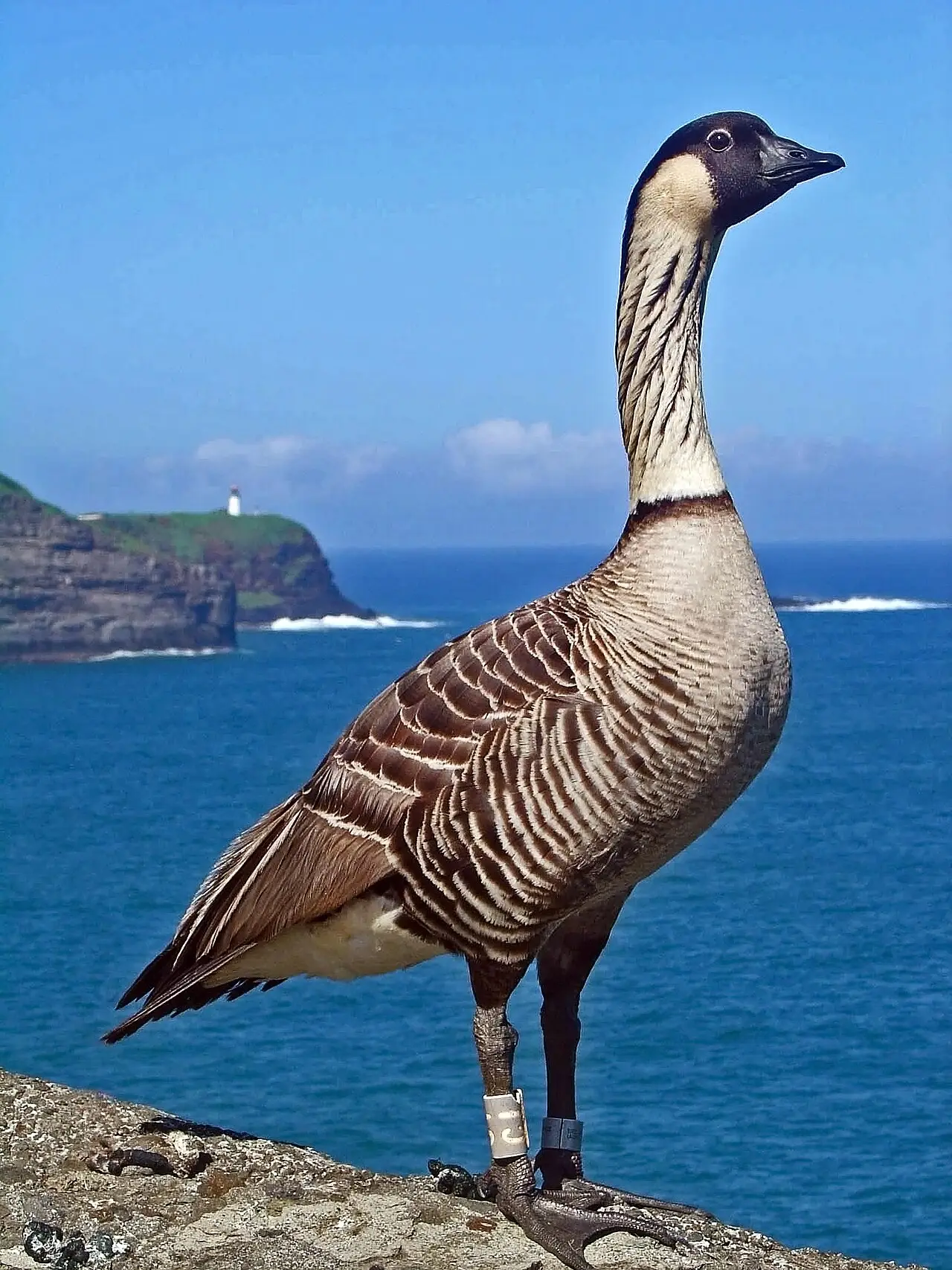
The nēnē is a medium-sized goose, about 25 to 27 inches long. Its head and the back of its neck are black, with a large buff-cream patch on each cheek. Its neck is pale with deep dark furrows that give it a grooved, striped look. The back is dark brown with broad white feather edges, and the underparts are paler and lightly barred.
The best clue to its way of life is its feet. A nēnē’s feet are only partly webbed, with long toes and strong legs, an adaptation for walking on rough lava rather than paddling on water. Its calls include soft mewing or mooing sounds, loud cackles when alarmed and typical goose honks.
A goose of the land
The nēnē is found only in the Hawaiian Islands, which gives it the smallest range of any goose in the world. It lives from sea level to alpine country more than 6,500 feet up, on lava flows, shrublands and grasslands, and it has also taken to pastures and golf courses.
Unlike most geese, it does not feed in water. It grazes on the leaves, seeds, fruits and flowers of grasses, herbs and shrubs. Pairs mate for life and nest on the ground under shrubs during a long breeding season, roughly October to March. Their eggs take about 30 days to hatch, the longest incubation of any goose.
Brought back from the edge
The nēnē came close to extinction. Hunting, habitat loss and introduced predators such as mongooses, cats and rats cut the wild population to about 30 birds in the 1950s. Captive breeding programs, in Hawaii and at the Wildfowl Trust in England, raised birds for release; predator control and fenced nesting areas helped them survive.
The recovery has been slow but real. The nēnē was listed as federally endangered in 1967, and in 2019 it was downlisted to threatened. The IUCN estimates there are now about 1,700 to 2,200 mature birds, and more than 60 percent of the population lives on Kauaʻi. The species still depends on active management.
Where to see one
On Kauaʻi, nēnē are common enough that they are often seen in parks, neighborhoods and on golf courses, sometimes walking across roads, where drivers are asked to slow down. On Maui, Haleakalā National Park has nēnē living roughly between 5,500 and 8,000 feet on the volcano’s slopes. Hawaiʻi Volcanoes National Park on the island of Hawaiʻi offers sightings against a backdrop of lava fields. Never feed them: feeding draws them to roads and parking lots, where many are killed by cars.
The state bird since 1988
Hawaii adopted the nēnē as its state bird in 1988. The law, now section 5-17 of the Hawaii Revised Statutes, spells its scientific name Branta sandwicensis; ornithologists now spell it Branta sandvicensis.
Questions about the Hawaii state bird
- What is the state bird of Hawaii?
- The nēnē, or Hawaiian goose (Branta sandvicensis), adopted in 1988.
- Is the nēnē endangered?
- It was federally listed as endangered from 1967 until 2019, when it was downlisted to threatened. It still depends on active management, such as predator control and fenced nesting areas.
- Where can I see a nēnē?
- On Kauaʻi, where more than 60 percent of the population lives, they are often seen in parks, neighborhoods and on golf courses. Haleakalā National Park on Maui and Hawaiʻi Volcanoes National Park on the island of Hawaiʻi are also good places.
- Why is it called nēnē?
- The name imitates its soft call.
Sources
- Hawaiian Goose overview Cornell Lab of Ornithology
- Nēnē at Haleakalā National Park Service, Haleakalā National Park
- HRS § 5-17 (state bird) Hawaii State Legislature (via Internet Archive)