Flag of Connecticut
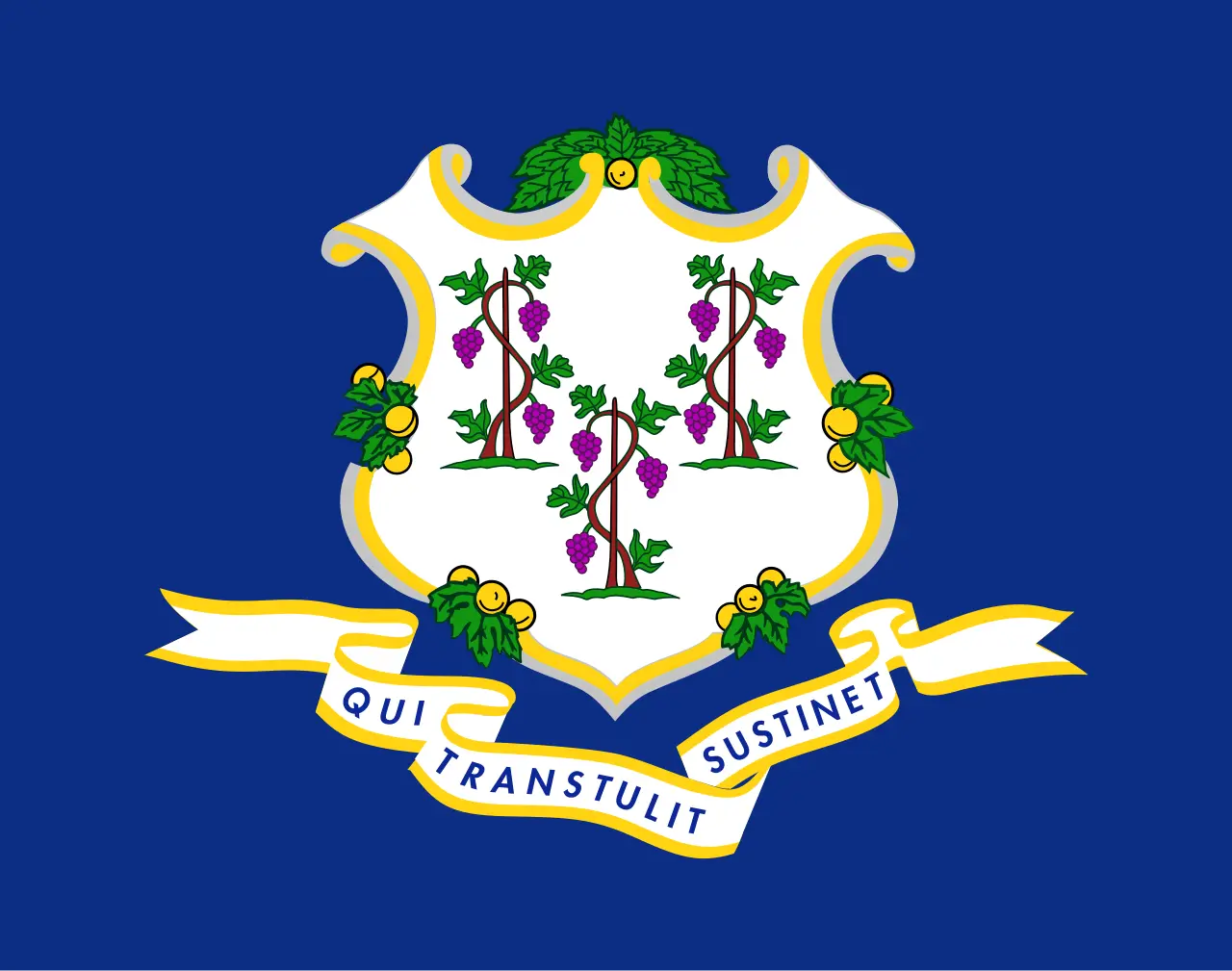
The flag of Connecticut is azure blue, with the state arms in the center: a white shield bearing three fruiting grapevines, bordered in gold and silver with oak leaves and acorns, above a white streamer with the motto QUI TRANSTULIT SUSTINET. The General Assembly adopted it in 1897, as a compromise between three competing proposals.
A compromise of three proposals
Before the 1890s Connecticut had no official flag. It used various banners on state occasions, including the blue regimental colors its troops had carried in the Civil War. In 1895 the Anna Warner Bailey Chapter of the Daughters of the American Revolution, from Groton, sent the legislature a memorial asking for an official state flag. On May 29, 1895, Governor O. Vincent Coffin proposed one, and the General Assembly appointed a special committee the same day.
Three groups had ideas. The DAR chapter had its own design. James J. Goodwin of the Connecticut Society of Colonial Wars proposed another. And Civil War veterans wanted to keep the blue of the regimental flags. The design adopted in 1897 combined them: the state arms on a blue silk field. As a reward for starting the effort, the DAR chapter was allowed to present the first flag made under the new law. No single designer is credited.
What the flag shows
- The blue field. Azure blue, kept from Connecticut’s Civil War regimental flags.
- The shield. A white shield of rococo design carrying the state arms.
- Three grapevines. Each vine bears fruit and is tied to a support. The law assigns no meaning, but the Connecticut State Library says they most likely represent the first three English towns, Hartford, Windsor and Wethersfield. Some accounts say they stand for the three colonies of Connecticut, New Haven and Saybrook.
- The border. Gold inside and silver outside, decorated with clusters of white oak leaves and acorns. The white oak is the state tree.
- The streamer. A white ribbon below the shield, cleft at both ends and edged in gold, with the motto in dark blue block letters: QUI TRANSTULIT SUSTINET, “He who transplanted still sustains.”
By law the flag measures five feet six inches long and four feet four inches wide.
An old motto and older vines
The flag is new compared with its symbols. The grapevines and the motto go back to the seal of the Saybrook Colony, brought from England in 1639, and the motto has appeared in some form on every Connecticut colonial and state seal since. The vines suggest a people transplanted to a new land and flourishing there, which is what the motto says.
The 1990 rewrite
In 1990 the legislature rewrote the official description of the flag and the arms, in Public Act 90-156. The new text specifies details the old one left open, such as the direction in which the vines twist, the oak-leaf-and-acorn border and the exact lettering on the streamer. The description is now in section 3-107 of the Connecticut General Statutes.
Questions about the Connecticut state flag
- What do the grapevines on the Connecticut flag mean?
- The law gives them no official meaning. State historians say they most likely stand for the first three English towns, Hartford, Windsor and Wethersfield; some accounts say they represent the colonies of Connecticut, New Haven and Saybrook.
- What does Qui Transtulit Sustinet mean?
- It is Latin for "He who transplanted still sustains," usually read as a reference to the colonists being brought to a new land and supported there. The motto has appeared on Connecticut's seals since 1639.
- When was the Connecticut flag adopted?
- In 1897. The governor proposed an official flag in 1895, prompted by the Daughters of the American Revolution.
- Why is the Connecticut flag blue?
- Civil War veterans wanted the state to keep the blue of the regimental flags Connecticut troops had carried, and the 1897 design did.
Sources
- The State Flag State of Connecticut
- Connecticut's state flag ConnecticutHistory.org
- C.G.S. § 3-107 (state flag) Connecticut General Assembly
- Connecticut State Seal and Arms ConnecticutHistory.org (CT Humanities)