White pine cone and tassel, Maine's state flower
Maine's state flower is not a flower at all. The official floral emblem, adopted in 1895, is the cone and tassel of the eastern white pine, the tree whose timber built Maine. Fifty years later, in 1945, the white pine itself became the state tree, so the same species fills two roles among Maine's symbols.
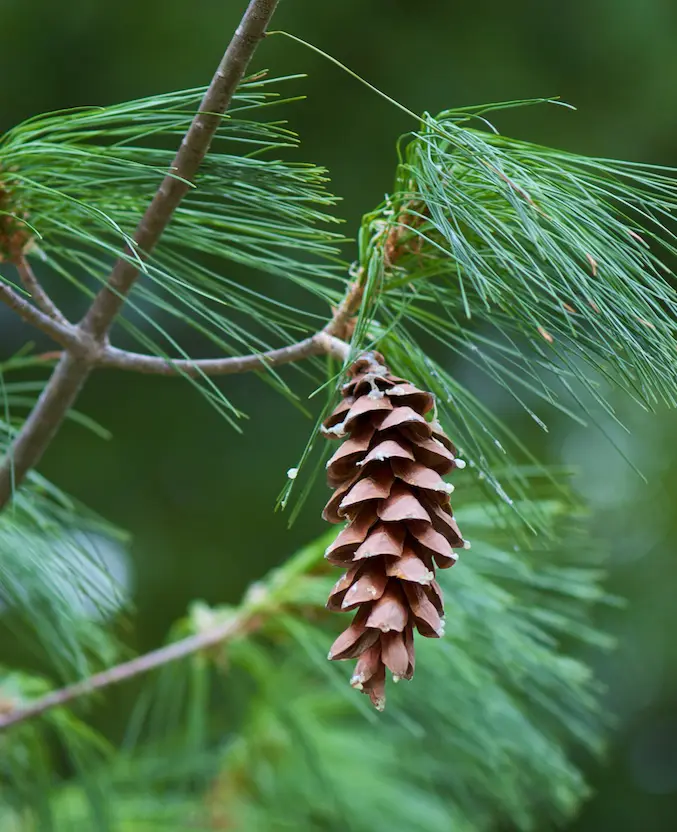
A cone, not a flower
Pines do not have flowers. Like other conifers, they produce their seeds in cones. When Maine’s legislature chose a floral emblem in 1895, it picked the cone and tassel of the eastern white pine, the tree most closely tied to the state’s history and economy. The law, now section 211 of Title 1 of the Maine Revised Statutes, names “the pine cone and tassel.”
How to recognize it
White pine cones are long and slender, four to eight inches, often slightly curved, and they hang from the branches on long stalks. Their thin scales have no prickles and are often coated in fragrant, sticky resin. The cones take two growing seasons to mature, opening to release their winged seeds in late August and September of their second year.
The “tassel” is the cluster of needles around them. White pine needles come in bundles of five, which makes the tree easy to identify: they are soft, flexible, bluish green and about two and a half to five inches long.
The tree behind the emblem
The eastern white pine is native to Maine and grows in every part of the state. It is often considered the largest conifer in the northeastern United States, commonly 70 to 80 feet tall and often reaching 100, and it can live about 450 years. Its tall, straight trunks made it the prize of colonial shipbuilders: in 1691 England’s “Broad Arrow” policy reserved the biggest pines near water as masts for the Royal Navy. The Maine Forest Service lists a champion white pine in Morrill, about 125 feet tall.
Where to see it
Look under white pines anywhere in Maine, in woods, along roads and in town parks, and you will find their cones on the ground. The trees are easy to spot from a distance by their layered, horizontal branches and soft, feathery look.
Two symbols from one tree
Maine adopted the pine cone and tassel as its floral emblem in 1895. Fifty years later, in 1945, the legislature named the white pine itself the state tree. The pine also appears at the center of the state seal and flag, and it gave Maine its traditional nickname, the Pine Tree State.
Questions about the Maine state flower
- What is the state flower of Maine?
- The white pine cone and tassel, adopted as the state floral emblem in 1895. It is not a true flower but the cone and needle cluster of the eastern white pine (Pinus strobus).
- Does Maine have a state wildflower?
- No. Maine has no separate state wildflower.
- Is the white pine also Maine's state tree?
- Yes. The white pine became the state tree in 1945, fifty years after its cone and tassel became the floral emblem.
- What does "tassel" mean in Maine's floral emblem?
- The tassel is the soft cluster of long needles at the tip of a white pine twig, which hangs like a tassel around the cone.
Sources
- Maine Revised Statutes, Title 1, §211 (floral emblem) Maine Legislature
- State Flower Maine Secretary of State
- Eastern White Pine Maine Forest Service
- Pinus strobus Native Plant Trust (Go Botany)
- Maine Revised Statutes, Title 1, §223: No enhanced protection Maine Legislature, Office of the Revisor of Statutes