Chickadee, the state bird of Maine
The state bird of Maine is the chickadee, identified by the state as the black-capped chickadee, adopted in 1927. It is a tiny, bold songbird with a black cap and bib, and it stays in Maine all winter, surviving bitter cold on a diet of seeds and stored food. It is one of the most familiar visitors to Maine's backyard feeders.
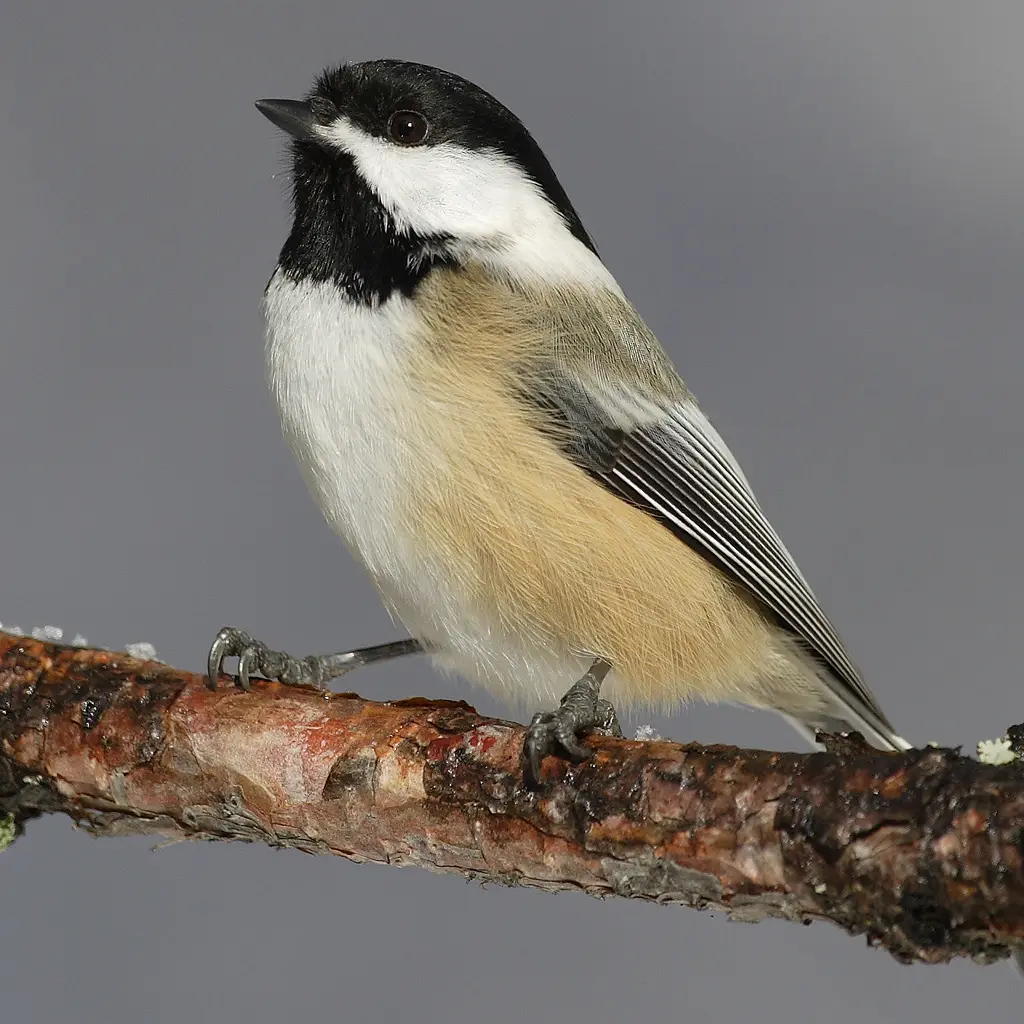
How to recognize it
The black-capped chickadee is tiny, only about five to six inches long and weighing less than half an ounce. It has a black cap and a large black bib, white cheeks, a gray back and a buffy wash along its sides. Its head looks large for its size, its bill is short and straight, and its tail is fairly long. Males and females look alike.
The bird is named for its call, a buzzy chick-a-dee-dee-dee. The more dee notes it adds, the more alarmed it is. Its song is a clear, sweet two-note whistle, fee-bee, with the second note lower.
How it lives
Chickadees are acrobats. They hop along twigs and often hang upside down to pick insects off the undersides of branches and leaves. In summer they eat mostly caterpillars and other insects; in winter seeds and berries make up as much as half their diet. They also hide seeds and other food in bark and crevices to retrieve later, remembering thousands of hiding places.
In winter they travel in small flocks, often joined by nuthatches, creepers and kinglets. They nest in tree cavities, which the pair digs out or enlarges in soft, rotting wood.
Where to see one in Maine
Chickadees live in Maine all year and are common in woodlands and at backyard feeders throughout the state. They favor mixed and deciduous woods, forest edges and thickets, especially where birches or alders grow, and they readily come to feeders with sunflower seed or suet. They are famously tame and can sometimes be coaxed to take seed from an outstretched hand.
Doing well
The black-capped chickadee is not of conservation concern. Partners in Flight estimates its global breeding population at about 43 million, and Breeding Bird Survey data show a slight overall increase between 1966 and 2019.
The state bird since 1927
A 1927 resolve presented by Representative Fuller of Southwest Harbor declared the chickadee Maine’s state bird. The law, now section 209 of Title 1 of the Maine Revised Statutes, simply names “the chickadee”; the Secretary of State identifies it as the black-capped chickadee. Massachusetts chose the same bird in 1941.
Questions about the Maine state bird
- What is the state bird of Maine?
- The chickadee, which the Maine Secretary of State identifies as the black-capped chickadee (Poecile atricapillus). It became the state bird in 1927.
- Which other state has the chickadee as state bird?
- Massachusetts, which adopted the black-capped chickadee in 1941.
- How do chickadees survive Maine winters?
- They eat seeds and berries along with insects, hide food to find later, travel in small flocks, and can lower their body temperature at night to save energy.
Sources
- Black-capped Chickadee National Audubon Society
- Black-capped Chickadee life history Cornell Lab of Ornithology
- State Bird Maine Secretary of State
- Maine Revised Statutes, Title 1, §209: State bird Maine Legislature, Office of the Revisor of Statutes