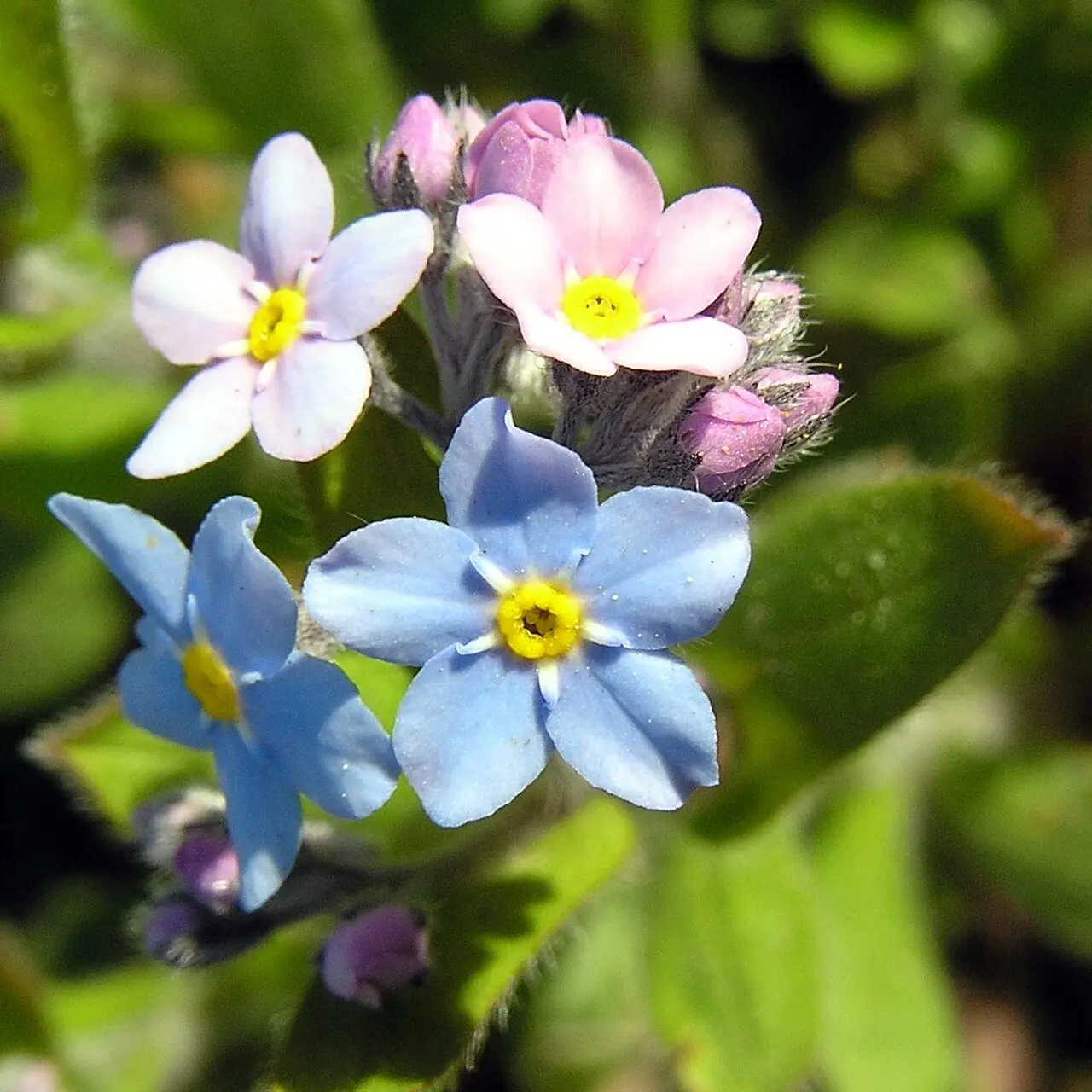
Forget-me-not, the state flower of Alaska
The state flower of Alaska is the wild native forget-me-not, a small blue wildflower with a yellow center that grows in alpine meadows across the state. The territorial legislature adopted it in 1917, making it Alaska's oldest official symbol. The forget-me-nots sold in seed packets are usually a different, non-native species.
How to recognize it
The alpine forget-me-not is a small perennial, usually only a few inches to about a foot tall. Its slender stems end in a cluster of tiny flowers, each no more than about a quarter of an inch across. Each flower has five rounded, sky-blue petals joined into a short tube, around a bright yellow center.
Watch the flower cluster over a few days and you will see it unroll. The buds are packed into a tight coil, like a scorpion’s tail, and it straightens as new flowers open toward the tip.
Botanists separate it from introduced look-alikes by the hairs on the calyx, the green cup under the petals. On the native alpine forget-me-not those hairs stand out and are hooked at the tip; on the European water forget-me-not they are straight and lie flat.
Where it grows
The alpine forget-me-not is native to Alaska, Canada and parts of the lower 48 states. In Alaska it grows throughout the state in alpine and subalpine meadows and on open slopes, and it blooms from about May into June. The National Park Service notes that in Bering Land Bridge National Preserve, on the Seward Peninsula, it flowers in May and June.
Wild flower, garden problem
The forget-me-nots in seed packets and garden centers are usually not Alaska’s native plant. They are mostly European species such as the woodland forget-me-not, Myosotis sylvatica. The University of Alaska Fairbanks Cooperative Extension Service and Anchorage gardening writers warn that these garden plants can spread aggressively and escape into the wild, where they crowd out native plants. The native alpine forget-me-not does not behave that way. If you want the state flower in a garden, look for the native species.
“On every hill and in every valley”
Alaska adopted the forget-me-not in 1917, five years after it became a territory and more than forty years before statehood, which makes it the oldest of Alaska’s official symbols. The act, approved April 28, 1917, described it as a little wildflower growing on every hill and in every valley and called it the emblem of Alaska’s pioneers.
Today’s law, section 44.09.050 of the Alaska Statutes, still names only “the wild native forget-me-not,” without a species. The identification as the alpine forget-me-not comes from the University of Alaska Fairbanks Cooperative Extension Service.
Questions about the Alaska state flower
- What is the state flower of Alaska?
- The wild native forget-me-not, usually identified as the alpine forget-me-not (Myosotis alpestris subsp. asiatica, also called Myosotis asiatica). The law names it only as "the wild native forget-me-not."
- When was the forget-me-not adopted?
- In 1917, by an act of the territorial legislature approved April 28, 1917. It carried over as the state flower at statehood in 1959.
- Should I plant forget-me-nots in my Alaska garden?
- The native alpine forget-me-not is fine, but most garden forget-me-nots sold in seed packets are non-native species, such as the woodland forget-me-not, which University of Alaska experts warn can spread aggressively into the wild.
Sources
- Laws of Alaska 1917, ch. 10 (territorial flower) Alaska State Legislature
- "Don't plant a problem" University of Alaska Fairbanks Cooperative Extension Service
- Myosotis asiatica plant profile USDA PLANTS Database
- Wildflowers of Bering Land Bridge National Preserve National Park Service
- Alaska Statutes AS 44.09.010-44.09.080 (state seal, flag, song, motto, flower, bird, tree) Alaska State Legislature
- Alpine forget-me-not (Myosotis asiatica) - Plant of the Week (archived copy, captured 2026-01-23) USDA Forest Service (via Internet Archive)
- Why I kill forget-me-nots whenever I can - and you should too Anchorage Daily News