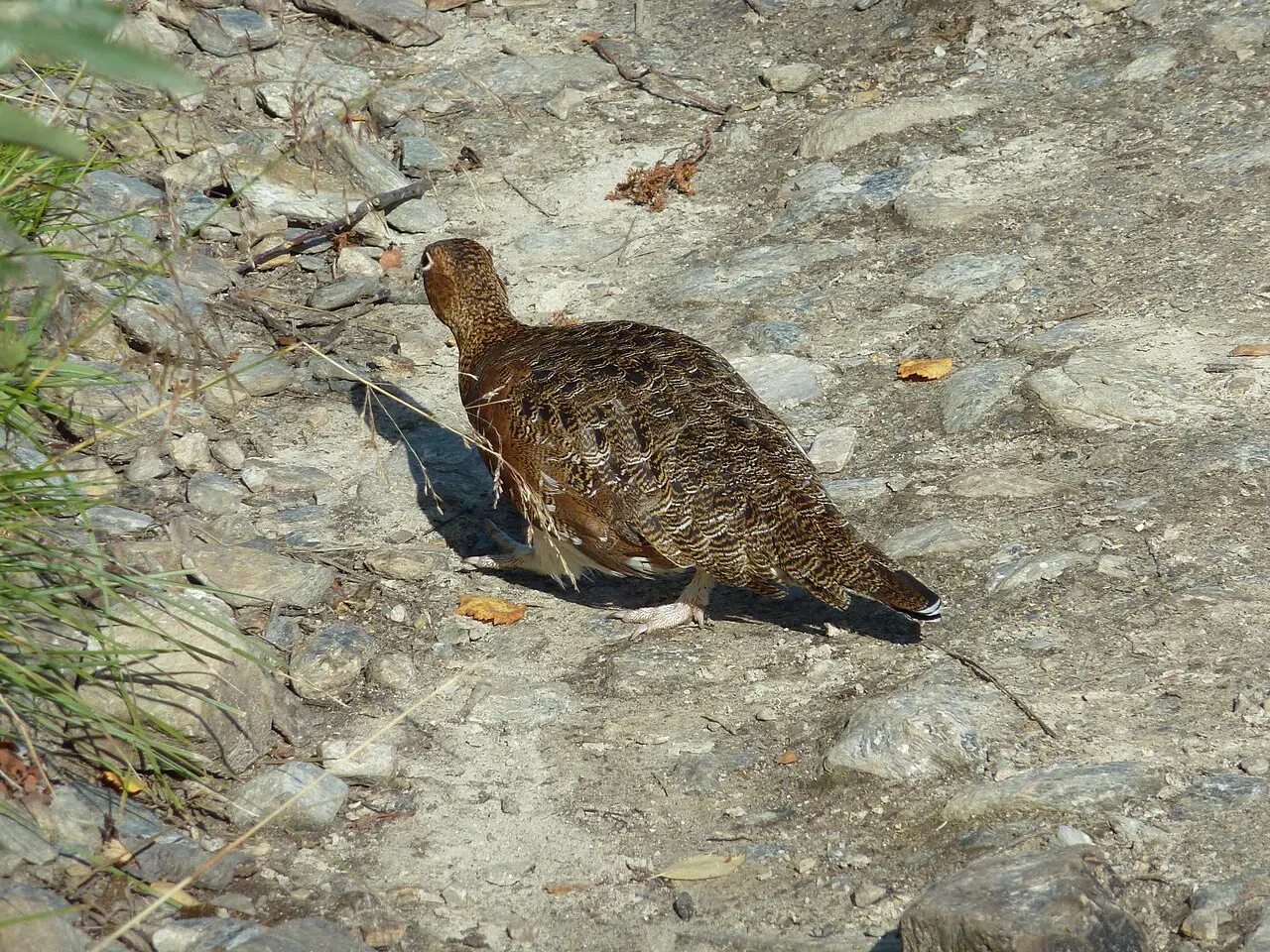
Willow ptarmigan, the state bird of Alaska
The state bird of Alaska is the willow ptarmigan, a plump Arctic grouse that changes color with the seasons: snow white in winter, reddish brown in summer. Schoolchildren chose it in 1955, when Alaska was still a territory. Within the United States it lives only in Alaska.
How to recognize it
The willow ptarmigan is a chunky grouse about 14 to 17 inches long, weighing one to nearly two pounds. It is the largest of Alaska’s three ptarmigan species and has a noticeably thick bill.
What it looks like depends on the season. In winter both males and females are pure white except for black outer tail feathers, and their feet are covered in dense feathers that work like snowshoes. In spring the male changes first, growing a chestnut-red head and neck while his body is still white, then turning reddish brown all over except for his white wings. Females are mottled brown all summer, which hides them on the nest.
In spring you may hear a male before you see him. Courting males give a loud, rapid call usually written as go-back, go-back, go-back, and raise bright red combs over their eyes.
Where it lives
Willow ptarmigan live across the Arctic and subarctic of North America, Europe and Asia, in tundra, willow scrub and muskeg, usually at or beyond treeline. In Alaska they have the widest range of any upland game bird. They are missing mainly from the forested valleys of the Interior, the dense rainforest of Southeast Alaska and the western Aleutians.
How it lives
The willow ptarmigan is almost entirely a plant eater, and as its name suggests, it depends on willows. In summer it eats willow leaves; in winter, willow buds, twigs and catkins make up most of its food, along with berries and grit. Chicks start out eating insects.
Unusually for a grouse, the male stays with his mate and helps guard and raise the chicks. In September families join together into larger flocks for the winter.
Where to see one
The Alaska Department of Fish and Game recommends several places along the road system: the Chilkat Pass section of the Haines Highway, the Denali Highway, the Richardson Highway between Paxson and Black Rapids, the Parks Highway near Cantwell, and the streams along the Denali National Park road. Remote spots such as Anaktuvuk Pass in the Brooks Range can be even better. In summer look in willow thickets above treeline; in winter the birds move to lower elevations.
Booms and busts
Willow ptarmigan are common over their huge range, most of which is far from people. Their numbers rise and fall sharply from year to year. It is often said that they follow a regular cycle of nine or ten years, but the Alaska Department of Fish and Game says that pattern has not been proven for Alaska. They are hunted as game birds.
Chosen by schoolchildren
The ptarmigan became Alaska’s bird through a contest. In the early 1950s Territorial Sportsmen, Inc., backed by the Alaska Sportsmen’s Council, ran a vote among schoolchildren through the territorial Department of Education and the Alaska Native Service schools. About 6,000 children took part, and the willow ptarmigan won by far the most votes. The territorial legislature adopted it in an act approved February 4, 1955; the law names the Alaska subspecies, Lagopus lagopus alascensis. When Alaska became a state four years later, the territorial bird became the state bird.
Questions about the Alaska state bird
- What is the state bird of Alaska?
- The willow ptarmigan (Lagopus lagopus). It became the territorial bird in 1955 and carried over as the state bird in 1959.
- Why does the willow ptarmigan turn white?
- It molts into white feathers each fall, which hide it against the snow from predators such as foxes and hawks. In spring it molts back into brown summer plumage.
- Where can I see a willow ptarmigan in Alaska?
- In willow thickets above treeline in summer and at lower elevations in winter. The Alaska Department of Fish and Game suggests the Chilkat Pass on the Haines Highway, the Denali Highway, the Richardson Highway between Paxson and Black Rapids, and the Parks Highway near Cantwell.
- Do willow ptarmigan live in other states?
- No. Within the United States the willow ptarmigan lives only in Alaska, although rare strays have turned up in Maine and New York. It also lives across northern Canada, Europe and Asia.
Sources
- Willow Ptarmigan species profile Alaska Department of Fish and Game
- Willow Ptarmigan National Audubon Society
- Laws of Alaska 1955, ch. 1 (HB 2), official bird Alaska State Legislature
- "Refuge Notebook: Alaska's state bird is one of a kind" Peninsula Clarion
- Alaska Statutes AS 44.09.010-44.09.080 (state seal, flag, song, motto, flower, bird, tree) Alaska State Legislature