The camellia, Alabama's state flower
The state flower of Alabama is the camellia (Camellia japonica), adopted in 1959. It is an evergreen shrub from East Asia, not a native plant, prized for large white, pink or red flowers that open in the coolest months of the year. It replaced the goldenrod, Alabama's first state flower, and since 1999 the state has also had a native wildflower, the oak-leaf hydrangea.
How to recognize it
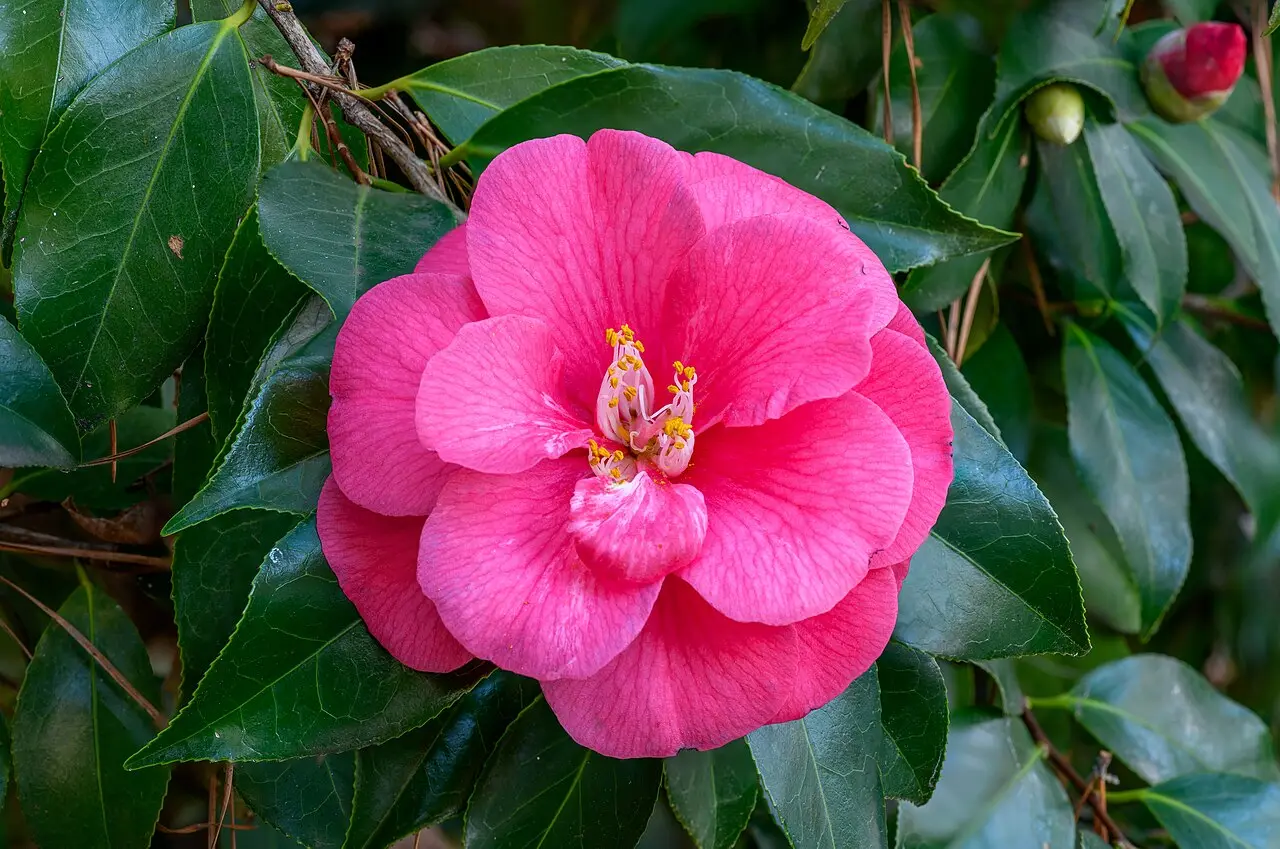
The camellia is an evergreen shrub or small tree in the tea family, usually about 10 to 13 feet tall in gardens. Its leaves are the first clue: glossy, dark green, leathery and finely toothed, about two to three inches long, and they stay on the plant all year.
The flowers are large, two to five inches across, and come in white and every shade from pale pink to deep red, sometimes streaked or edged in a second color. Wild camellias have a single ring of petals around a cluster of yellow stamens, but many garden varieties are double, with layer upon layer of petals like a rose.
What makes the camellia stand out is its timing. It blooms in the cool season, when little else is flowering. Depending on the variety, the first flowers can open as early as October and the last as late as March.
A flower from East Asia
The camellia is not native to Alabama or anywhere in North America. It comes from China, Korea and Japan, and the USDA lists it as an introduced plant in the lower 48 states. In Alabama it is a garden plant, grown in yards and public gardens across the state, especially in the mild south. The species named in the law, Camellia japonica, includes thousands of garden varieties, and the law covers them all.
Where to see camellias
One of the best places is Bellingrath Gardens and Home near Theodore, south of Mobile, where camellias are one of the signature collections and bloom through the cooler months. In towns across Alabama, especially in the southern half, camellias are common enough in front yards that a winter drive will show plenty of them.
From goldenrod to camellia
Alabama’s first state flower, chosen in 1927, was the goldenrod, a native wildflower. In 1959 the legislature replaced it with the camellia. The current law, section 1-2-11 of the Code of Alabama, names the species Camellia japonica as a whole, and requires that a specimen of the state flower be kept in the Auburn University Herbarium, the official state herbarium.
The native alternative: oak-leaf hydrangea
In 1999 the legislature added a state wildflower, and this time it chose a native plant: the oak-leaf hydrangea, Hydrangea quercifolia. It is a woodland shrub of the Southeast with large leaves shaped like oak leaves, cone-shaped clusters of white flowers in early summer and deep red fall color. The naturalist William Bartram described it during his travels through the South in the 1770s. A specimen of the wildflower must also be deposited at Auburn.
Good to know
NC State Extension lists the camellia as non-toxic to cats, dogs and horses, which makes it a safe choice for gardens with pets.
Questions about the Alabama state flower
- What is the state flower of Alabama?
- The camellia, Camellia japonica, adopted in 1959. Alabama's state wildflower is the oak-leaf hydrangea.
- What was Alabama's state flower before the camellia?
- The goldenrod, chosen in 1927. The legislature replaced it with the camellia in 1959.
- Is the camellia native to Alabama?
- No. It comes from China, Korea and Japan and is grown in Alabama as a garden plant. The state's native floral emblem is the oak-leaf hydrangea, its state wildflower.
- When do camellias bloom in Alabama?
- In the cool season. Depending on the variety, the first flowers can open in October and the last ones in March, with many at their peak in winter.
Sources
- Code of Alabama § 1-2-11 (State Flower and Wildflower) Alabama Legislature (ALISON)
- Camellia japonica North Carolina State Extension Gardener Plant Toolbox
- Camellia japonica plant profile USDA PLANTS Database
- Core plant collections Bellingrath Gardens and Home
- Quick Facts Encyclopedia of Alabama (Alabama Humanities Alliance)