Flag of Alabama
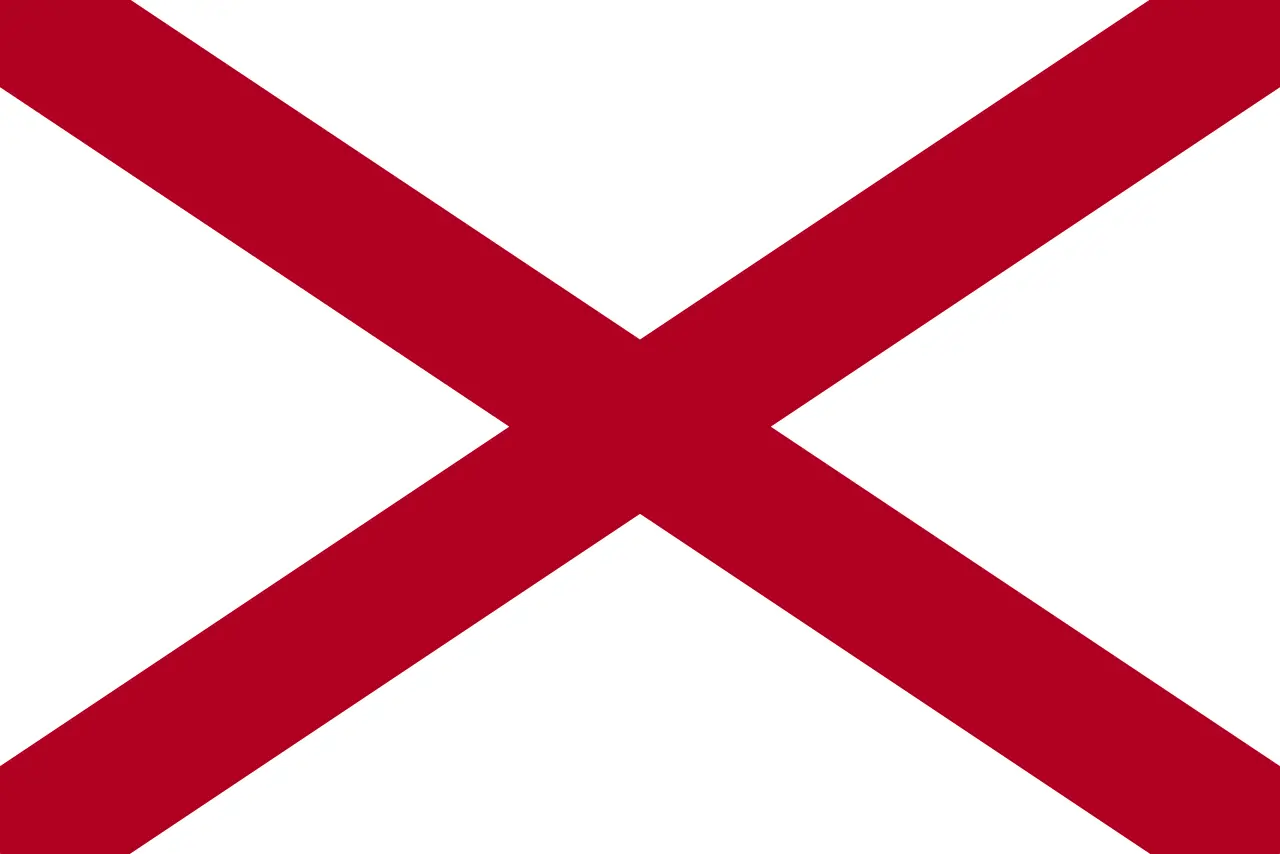
The flag of Alabama is a crimson cross of St. Andrew, a diagonal X, on a white field. The legislature adopted it on February 16, 1895. The law sets only two rules for the design: the bars must be at least six inches wide, and they must run all the way from corner to corner.
A two-sentence law
Alabama’s flag law is short. Section 1-2-5 of the Code of Alabama says the flag is a crimson cross of St. Andrew on a field of white, and that the bars of the cross must be at least six inches wide and must cross the flag diagonally from side to side. That is all. The law gives no proportions, no exact shade of crimson and no meaning for the colors or the cross.
Because it fixes no proportions, the flag can be made in different shapes. The Encyclopedia of Alabama notes that it is the only state flag that may be displayed as a square. In practice most Alabama flags are rectangles.
Where the design came from
The legislature adopted the flag on February 16, 1895. The bill was sponsored by Representative John Sanford Jr., a veteran of the 60th Alabama Infantry in the Civil War. Beyond that, surprisingly little is recorded. No designer is named in the law or the surviving records, and no debate explaining the choice has been found.
That gap has let a story take hold: that Sanford copied the square battle flag of the Confederacy, a blue cross with white stars on red. The diagonal cross does make the resemblance easy to see. But the Alabama Department of Archives and History has said that the historical record on why and how the design was chosen is thin, and that the battle flag explanation is a later supposition rather than a documented fact. The flag also resembles older designs built on the cross of St. Andrew, the patron saint of Scotland.
The flag of 1861
Alabama had flown a very different flag before. On January 11, 1861, the day the state voted to leave the Union, the secession convention was presented with a blue silk banner, painted largely by the Montgomery artist Francis Corra. It showed the Goddess of Liberty and the words “Alabama – Independent Now and Forever.” It flew over the Capitol until storm damage forced its removal on February 10.
The Archives stresses that this was the convention’s flag, not an officially adopted flag of a “Republic of Alabama.” It was carried off to Iowa after the war and returned to Alabama in 1939. It is now in the collection of the Alabama Department of Archives and History.
Flying the flag
A separate section of the Code, 1-2-6, sets rules for displaying the flag. The coat of arms, adopted in 1939, is a separate emblem with its own rules: it hangs above the speaker’s stand in each house of the legislature and in the governor’s office.
Questions about the Alabama state flag
- What does the Alabama flag look like?
- A white flag with a crimson diagonal cross, called a cross of St. Andrew or saltire, running from corner to corner. There is no seal, lettering or other emblem on it.
- Is the Alabama flag based on the Confederate flag?
- That is often said, but it has not been documented. The bill's sponsor in 1895 was a Confederate veteran, and some people believe he modeled the flag on his regiment's battle flag, but the Alabama Department of Archives and History says the record of why the design was chosen is thin and the claim is a later supposition.
- When was the Alabama flag adopted?
- On February 16, 1895. The description went into the Code of 1896 and is now section 1-2-5 of the Code of Alabama.
- Can the Alabama flag be square?
- Yes. The law describes only the cross and its width, not the flag's proportions, and the Encyclopedia of Alabama notes that it is the only state flag that may be displayed as a square.
Sources
- Code of Alabama § 1-2-5 (Flag of the State) Alabama Legislature (ALISON)
- Historical record thin on specifics regarding Alabama's flag design WAFF 48 News
- Alabama Secession Flag Alabama Department of Archives and History
- Quick Facts Encyclopedia of Alabama