The yellowhammer, Alabama's state bird
The state bird of Alabama is the yellowhammer, the local name for the northern flicker, a large brown woodpecker that flashes bright yellow under its wings and tail. The legislature adopted it in 1927, but the bird had already given Alabama its best-known nickname, the Yellowhammer State, during the Civil War.
A woodpecker in disguise
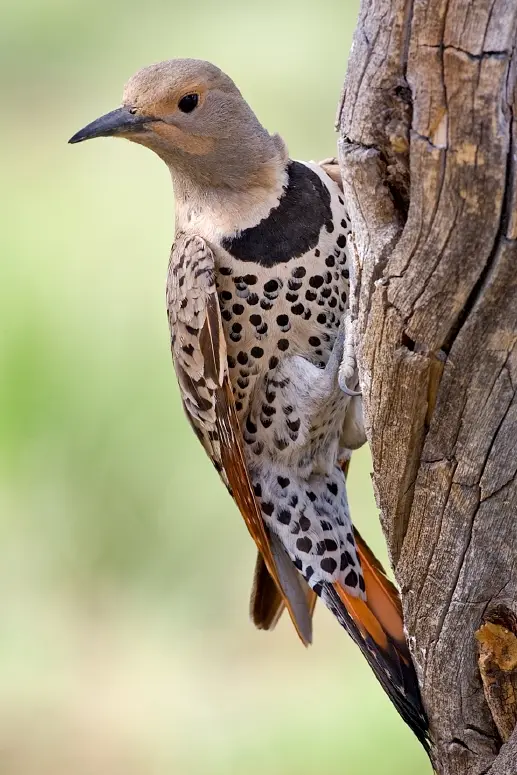
At first glance a yellowhammer does not look much like a woodpecker. It is a big, brown bird about 11 to 12 inches long, with black bars across its back, a black crescent on its chest and a pale belly covered in round black spots. The surprise comes when it flies. The undersides of its wings and tail flash bright yellow, and a white patch on its rump shows clearly as it bounds away in a dipping, up-and-down flight.
Eastern birds like Alabama’s are the yellow-shafted form of the northern flicker. They have a gray crown, a tan face and a red patch on the back of the neck. Males also have a black “mustache” stripe running back from the bill.
Its calls are easy to learn: a loud, ringing kleeer, and a long, repeated wicka-wicka-wicka. In spring flickers also drum on trees and poles in short bursts.
Why it feeds on the ground
Most woodpeckers find their food in trees. The flicker spends much of its time on the ground, probing lawns, fields and forest edges with its long bill. Its main food is ants, which it laps up with its long tongue, along with beetles and other insects. In fall and winter it adds fruit, berries and seeds.
It still needs trees to nest. Pairs dig nest holes in dead trees, stumps or utility poles, which is why flickers do best where open ground for feeding sits next to scattered dead wood. They avoid dense, unbroken forest.
Where to see one in Alabama
The yellowhammer lives in Alabama all year, in every part of the state. Look for it in open woodlands, parks, golf courses and suburbs with large trees, often hopping on a lawn rather than clinging to a trunk. Flickers also visit feeders that offer suet, sunflower seed or peanuts. Across North America the species breeds from Alaska to Central America.
Common, but declining
The northern flicker is still abundant: Audubon estimates the population at about 12 million birds. Surveys show that its numbers have fallen across much of its range since the 1960s, though. One pressure is the European starling, an introduced bird that competes with flickers for nest holes.
From soldiers’ uniforms to state law
The bird’s link to Alabama began with the Civil War. Some Alabama soldiers wore homespun uniforms dyed in shades that reminded people of the yellowhammer’s yellow-and-brown plumage, and the troops came to be called yellowhammers. After the war the nickname stayed with the state. In 1927 the legislature made it official in the other direction, naming the yellowhammer the state bird; the law, now section 1-2-7 of the Code of Alabama, uses the folk name “yellow-hammer.” Alabama remains the only state with a woodpecker as its state bird.
Questions about the Alabama state bird
- What is the state bird of Alabama?
- The yellowhammer, also called the northern flicker or yellow-shafted flicker (Colaptes auratus). It became the state bird in 1927.
- Why is Alabama called the Yellowhammer State?
- During the Civil War, the dyed homespun uniforms worn by some Alabama soldiers reminded people of the yellowhammer's yellow-and-brown feathers, and the troops were nicknamed yellowhammers. The name spread to the whole state.
- Is the yellowhammer a woodpecker?
- Yes. It is a woodpecker, but an unusual one: it does much of its feeding on the ground, where it digs for ants.
- Does Alabama have a state game bird?
- Yes. The wild turkey has been the state game bird since 1980.
Sources
- Northern Flicker National Audubon Society
- Northern Flicker Alabama Department of Conservation and Natural Resources
- Code of Alabama § 1-2-7 (State Bird) Alabama Legislature (ALISON)
- Northern Flicker Encyclopedia of Alabama
- Quick Facts Encyclopedia of Alabama (Alabama Humanities Alliance)